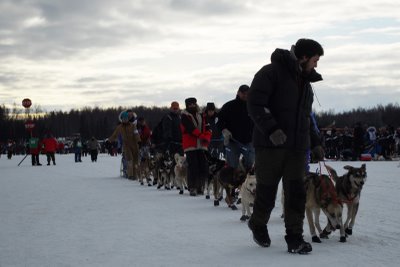
No one notices the tears welling up in my eyes. In the
breezy, ten-degree morning air of Anchorage, I figure it’s probably not unusual
for a man to have watery eyes. Crouching in the snow on Cordova Street at Fifth
Avenue, I press the shutter release on my ancient film camera and stand up just
as an exuberant team of 12 dogs races past. I smile and extend my
hand to the musher standing on the back of his sled. He returns my smile and
slaps my hand with his mitten as he passes. Before him lie 1,000 miles and up
to 15 days of snow-covered Alaskan wilderness. Something in me longs to join
him on his Odyssey.
I swallow hard.
Exuberant inadequately describes the dogs, lovingly
trained from puppies to run the Iditarod. As they run by my camera, their keen
eyes shining, muscles undulating, tongues lolling from their mouths, their
enthusiasm is palpable. They are smiling, almost laughing, with joy. One of
Deborah Molberg-Bicknell’s dogs veers toward me, trying to lick my face as he
passes. Deborah, laughing, calls out, “Sorry. He just wants his picture taken.”
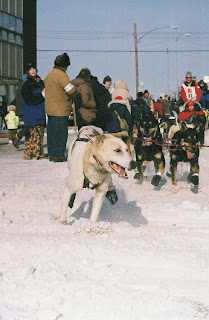
Later, as
another team approaches, I kneel only inches from their path, failing
to notice the spectator with the German shepherd who has approached the
racecourse from behind me. As the lead dogs fill my viewfinder, they
suddenly veer off course to the wrong side of my frame. The other dogs,
attempting to turn and follow as they've been trained, leap over me as I
scramble across the snow berms to avoid being struck by the sled. One woman is
struck and thrown to the ground, and the sled and musher nearly topple. Race attendants
and spectators scramble to control the dogs and set them back on course while a
policeman orders the man with the interloper to get back 100 feet from the
course. Moments later, the dogs and their musher are back on their way.
For the first time ever, it seems entirely appropriate for a
bubba from Georgia to stand dumbfounded in a crowd of people and mutter that
University of Georgia slogan, “How ‘bout them dogs!” For me, the
incantation will never have the same meaning.
I can’t compare the Iditarod to any other competitive event
I’ve witnessed. A 1,000-mile course over the most rugged, yet most beautiful
terrain nature has to offer. Combine jagged mountain ranges, frozen
rivers, dense forests, desolate tundra, storm-swept coastline, temperatures far
below zero, winds that can cause a complete loss of visibility or frozen
corneas, long hours of darkness, treacherous inclines and larger, more
dangerous animals than the dogs, and you have the Iditarod... a race
commemorating the 20 relay teams of dogs that, in 1925, raced from Nenana to
Nome delivering diphtheria vaccine to quell an epidemic... a race that embodies
the spirit of Alaska.

The next morning, Sunday, I drive north to Wasilla through some of the most breathtaking scenery imaginable — the towering, snow-covered Chugach mountains, the frozen waters of Knik Arm, valleys covered in spruce and birch, and more mountains—the Talkeetnas and the Alaska Range—in the distance. I want to stop and take pictures, but I can’t be late for the official restart of the Iditarod in the village of Willow. The ceremonial start held in Anchorage allows as many people as possible to see the dogs and mushers, but the actual race begins at the edge of the wilderness.
As I turn into the parking area, I catch my first, brief glimpse
of Denali. Although 75 miles away, its massive granite face commands the
horizon. From base to peak, 6,000 feet taller than Everest, Denali lives
up to its Native Alaskan name: The Great One.

In the race staging area, the mood is one
of camaraderie and especially affection for the dogs. Everywhere in the Willow
staging area, support team members are caring for the dogs, giving
them snacks, holding and patting them, talking to them, adjusting their booties
and harnesses. More than household pets, more than members of the family, these
dogs and their mushers are inextricably bonded to one another, a symbiosis
of sinew and spirit.
The dogs are also a mixture of breeds. Many obviously husky-malamute mixes, but some with reddish coats. Others almost entirely black. One entire team is composed of 16 pure white dogs. Some with eyes so blue they shine like fire.
The dogs are also a mixture of breeds. Many obviously
husky-malamute mixes, but some with reddish coats. Others almost entirely
black. One entire team is composed of 16 pure white dogs. Some with eyes
so blue they shine like fire.
The first mile of the course stretches across the
snow-covered, frozen surface of Knik Lake. The 20-ft. wide raceway is
delineated on either side by four-foot-high, orange plastic construction fence
stretching like a ribbon across the lake and over the hill on the western
shore. Several thousand spectators line the fence on either side.
The commentator
welcomes the crowd. Two little girls sing the national anthem. Then, the
first team of dogs approaches the starting line, but today,
rather than 12 dogs per sled, most teams are composed of 16 dogs, an indication
of the power and endurance needed to cross 1,200 miles of wilderness.

Handlers restrain the dogs to keep them from becoming
entangled in their leads.
Each pair of the eight pairs of dogs has
special talents and tasks. The lead dogs, leaner than the others, are bred for
their agility, sensory perception and fearlessness. The pairs that follow are
progressively stockier with massive shoulders and hind legs. Known as wheel
dogs, the two strongest and most obedient dogs run immediately in front of the
sled. It’s their job to turn both the sled and the other dogs at the
musher’s command of “gee” or “haw.”
The commentator delivers a bio of each musher as they
approach the starting line ... fishing guide, anthropologist, carpenter, FBI
agent, physician, biologist, psychiatrist. Most from Alaska, but some from
Colorado, Wyoming, Montana, Michigan, France, Germany, Norway. The majority are
men, but a number of them women, one highly favored to win. The youngest
musher only 21... today. The oldest in their 60s. Rookies, veterans, several
four-time winners and one five-time winner.
As the commentator speaks, he is
periodically interrupted by the starter. “You have one minute.” The
mushers check their dogs and their harnesses, embracing the lead dogs,
whispering in their ears, patting other dogs, ignoring some, presumably to
instill jealousy of the lead dogs, to make the team chase them.
“You have 30 seconds.” The mushers kiss their spouses and
children, embrace and shake hands with the dog handlers and scurry back to
their sleds. “Fifteen seconds.” The dogs are a mixture of emotions and
activity. Some howling with their heads in the air. Others leaping against
their harnesses, pawing at the snow with their bootie-protected paws. Some
look back at the musher as if to ask, “When are we leaving, already?” A few
quietly stand at the ready and an occasional dog nonchalantly reclines in the
snow, oblivious to the excitement.
The starter begins her countdown. “Ten,
nine, eight, seven...” and the dogs become charged with excitement. All barking
and straining against their harnesses. The handlers struggle to restrain
them. “Six, five, four...” The crowd begins to applaud and cheer. “Three, two,
one...” The handlers step clear. “Go.” A pause, then the musher calmly, almost
inaudibly calls “Hike.”
Snow explodes into the air from the booties of the dogs as
they lurch forward, instantly accelerating
from the chute. The mushers exchange
high fives with handlers and well-wishers as they race away across the frozen
lake. Camera shutters fire, motion picture cameras pan the action, and in
moments the dogs and their musher are across the lake and over the hill on the
other side where there are no spectators, no high fives ... only wilderness.
But as one team departs, another approaches the starting line. Three
minutes later, the riotous flurry of paws and flying snow and cheers repeat,
and every three minutes thereafter until all 82 teams are on their way to Nome.
Almost every spectator remains until all teams have departed ... the final
musher receiving the same enthusiastic send-off as the first.
By the time the last team has departed, the wind is picking up and the temperature has dropped back near zero. I pull my knit cap down over my ears, and my fur-ruffed hood over my head. I screw the lens cap onto my camera and, with my exposed fingers aching and on fire from the bitter cold, I struggle to don my down-insulated gloves.
And as I walk away from the silent, frozen lake, I turn my gaze to the north. Denali, set against a deepening blue sky, looms on the horizon, glowing a pale rose hue in the late afternoon... the Great One watching over Alaska and the men and women of the Iditarod.
No one notices the tears welling up in my eyes.
Labels: Alaska, Iditarod, John Drew Journalist, John Drew Photography, John Drew Pictures, John Drew Writer